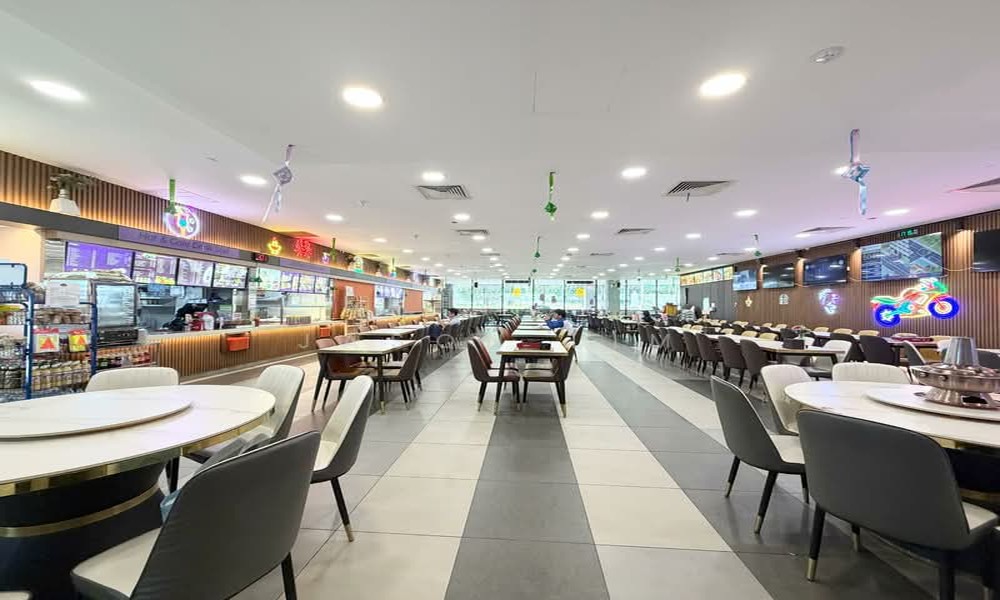
An industrial canteen for rent in Singapore represents a business opportunity that sits at the intersection of reliable daily demand, a captive customer base, and the operational infrastructure of Singapore’s extensive industrial estate network.
The Industrial Canteen Market in Singapore
Singapore’s industrial estates – from Jurong to Tuas, from Ubi to Woodlands, from Senoko to Kaki Bukit, house hundreds of thousands of workers across manufacturing, logistics, engineering services, and industrial support functions. These workers need to eat. Most industrial facilities do not provide on-site food preparation for their staff, relying instead on canteens operated by independent food operators within the estate or the building.
This creates a consistent, location-bound demand for food service that is structurally different from street-level F&B in a mixed-use area. Industrial canteen customers are not passing through traffic. They are the same group of people, at the same facility, every working day. The demand is predictable, the customer base is captive during working hours, and the competition is typically limited to whatever other food options exist within reasonable walking distance of the facility.
Types of Industrial Canteen Spaces Available
Industrial canteen for rent opportunities in Singapore take several forms:
- Purpose-built estate canteens: facilities within JTC industrial parks or flatted factory developments specifically designed and permitted for food and beverage operations. These typically include adequate ventilation, cooking gas or electrical provisions, grease trap infrastructure, and wash-up areas.
- Ground floor F&B spaces within flatted factories: units at the base of multi-storey factory developments that are allocated for food service to support the building’s occupants.
- Stand-alone canteen buildings: dedicated single-storey buildings within an industrial estate allocated entirely to food and beverage operations, sometimes accommodating multiple stall operators under a single canteen management structure.
- Converted industrial units adapted for F&B use: subject to planning and building permits for the change of use and the installation of appropriate cooking, ventilation, and waste treatment infrastructure.
Who Operates Industrial Canteens
Industrial canteen operators in Singapore fall into two broad categories: individual hawker-style operators running a single stall or small food business within a larger canteen, and canteen management companies that take on the full tenancy of a multi-stall canteen space and then sublease individual stalls to food operators.
For a prospective industrial canteen tenant in Singapore, the approach depends on scale. An individual operator looking to run a single stall seeks a space within an existing managed canteen. A canteen management company or larger F&B operator looks for an entire canteen space to operate and manage.
Regulatory Requirements for F&B in Industrial Zones
Operating a food business in an industrial canteen requires compliance with several regulatory frameworks:
- Singapore Food Agency (SFA) licensing: all food businesses must hold an appropriate SFA food shop licence. The application requires a compliant premises layout, hygienic food handling facilities, and adequate waste management.
- URA permitted use: the premises must be approved by the Urban Redevelopment Authority for food and beverage use. In industrial zones, this is typically a controlled use that must be specifically permitted for the building or unit.
- Building and fire safety compliance: kitchen exhaust systems, grease traps, fire suppression equipment, and ventilation must meet the requirements of the Building and Construction Authority and the Singapore Civil Defence Force.
“Rules are the framework within which initiative can flourish. Know the rules before you operate within them.” – Lee Kuan Yew
Understanding the regulatory framework before signing a tenancy is the essential prerequisite for a successful industrial canteen operation.
Assessing a Canteen Opportunity
Before committing to an industrial canteen tenancy in Singapore, a prospective operator should assess:
- The worker population served: what is the total headcount of workers within practical lunchtime walking distance?
- Existing competition: how many other food options are accessible to the same worker population?
- Operating hours: are the workers shift-based, and does this create demand outside standard meal times that the operator can or should serve?
- Infrastructure condition: Is the canteen space properly equipped with the utility connections, ventilation, and drainage infrastructure required for the intended menu?
- Tenancy terms: what is the rental level, the lease term, and the exit conditions?
Building a Successful Industrial Canteen Business
Industrial canteen operators who succeed in Singapore’s estate environment understand that consistency is the foundation of their business. Workers return to the same canteen because the food is reliably good, the service is quick during the lunch rush, and the prices are fair. An industrial canteen for rent in Singapore, chosen with careful assessment of the market and operated with consistent quality, provides a stable, repeatable business built on the daily needs of the industrial workforce it serves.