
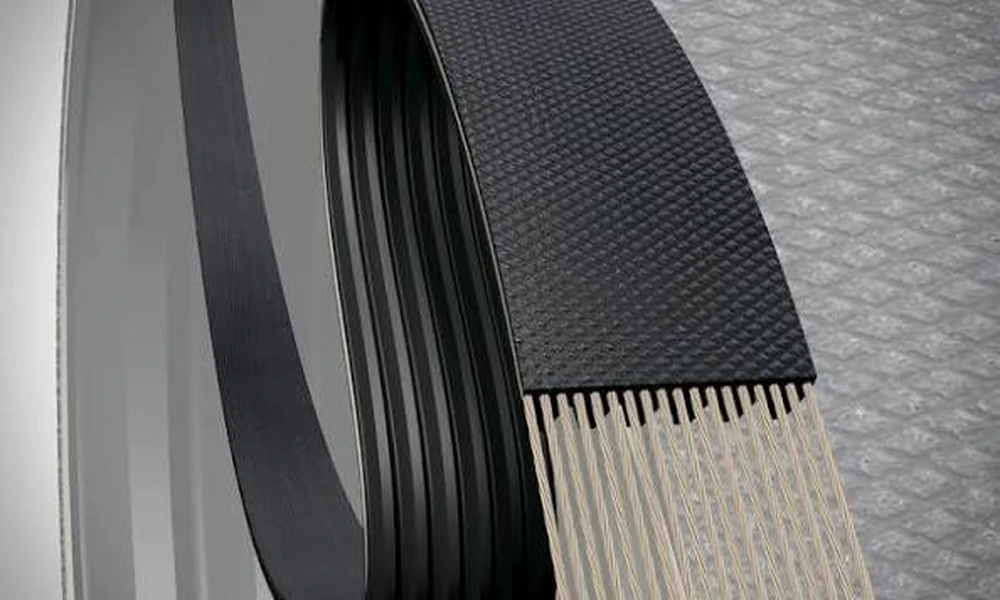
A Poly V belt, also known as a multi-ribbed belt or ribbed V belt, is a flat belt with longitudinal V-shaped ribs running along the inner surface. These ribs engage with corresponding grooves in a pulley, creating multiple points of contact between the belt and the pulley surface. The result is a drive that combines the flexibility and low profile of a flat belt with the grip and power transmission efficiency associated with the wedge action of a V belt.
The design emerged as a solution to applications where classical V belts or flat belts were either too bulky, too stiff, or insufficiently efficient. The ribbed profile allows Poly V belts to run on smaller diameter pulleys than classical V belts, which is particularly valuable in applications where compact dimensions are a priority.
Key Performance Characteristics
The multiple rib contact of a Poly V belt distributes the transmitted load across a wider cross-sectional area than a single V belt of equivalent overall width. This distribution reduces unit contact pressure, which in turn reduces heat generation and extends belt life. The lower flex stiffness compared to classical V belts also means that less energy is consumed in bending the belt around the pulley, contributing to higher transmission efficiency.
Poly V belts are capable of transmitting substantial power at high speeds. The combination of high speed capability with compact dimensions makes these well suited to applications in automotive accessories and appliances where both factors are required simultaneously.
Applications in the Automotive Sector
The most widely recognised application of Poly V belts is in automotive engine front-end accessory drives, often referred to as serpentine drives. A single Poly V belt typically drives the alternator, power steering pump, air conditioning compressor, and water pump from the crankshaft, routing around multiple pulleys in a serpentine path.
The serpentine configuration requires a belt that can run on the back surface as well as the ribbed inner surface, that can accommodate reverse bends, and that remains stable at the high speeds of an engine running at several thousand revolutions per minute. Poly V belts meet all of these requirements and have largely replaced the multiple V belt arrangements that earlier automotive designs used.
Industrial Machine Applications
Beyond the automotive sector, Poly V belts are used extensively in washing machines and tumble dryers, where compact drive arrangements with low vibration are required for domestic appliance applications. The belt connects the motor to the drum, transmitting drive efficiently in a confined space.
Industrial applications include woodworking machinery, printing equipment, textile machinery, and conveyors where the low profile and high efficiency of Poly V belts provide advantages. Machine tools that require precise, low-vibration drives benefit from the smooth engagement of the ribbed profile.
- Rib cracking from flexural fatigue – common with small diameter pulleys
- Glazing of rib surface – caused by incorrect tension or oil contamination
- Rib separation or delamination – indicates overloading or manufacturing defects
- Edge cord failure – typically from misaligned pulleys or installation damage
Selecting the Right Poly V Belt
Poly V belts are manufactured to standard cross-sections designated by letters – typically J, K, L, M – where the letter denotes the rib pitch. Smaller rib pitches are used for high-speed, lower-power applications, while larger pitches are selected for higher power transmission. The belt designation also includes the number of ribs and the effective length, both of which must match the application requirements.
When replacing a Poly V belt, matching the original specification precisely is important. Substituting a belt with a different rib pitch, different length, or different material specification can result in slip, noise, premature wear, or failure. The pulley groove geometry is designed for a specific rib profile, and mismatches affect contact quality and heat generation.
Correct tensioning is also critical. Unlike classical V belts, which rely on wedging action that accommodates modest tension variation, Poly V belts require accurate tensioning to maintain the rib-to-groove contact necessary for efficient power transmission without slipping.
Service Life and Common Failure Modes
The service life of a Poly V belt depends on the application, operating conditions, and whether installation and tensioning were performed correctly. Under ideal conditions, a Poly V belt in an automotive accessory drive may last 100,000 kilometres or more. In industrial applications with continuous duty cycles, replacement at the intervals recommended by the manufacturer is standard practice. Choosing suitable products from industrial belt manufacturers India can help ensure the belt meets the application’s operating and performance requirements.
Common failure modes include rib cracking from flexural fatigue, particularly in applications with small diameter pulleys or high cycling rates. Glazing of the rib surface, which reduces the coefficient of friction and leads to slip, results from incorrect tension or oil contamination. Rib separation or delamination indicates either manufacturing defects or operation in conditions outside the belt’s rated capacity.
Inspection for these failure modes during routine maintenance, combined with tension checking and pulley groove inspection, identifies developing problems before unexpected failure. A belt showing signs of wear, cracking, or glazing should be replaced before the rib condition deteriorates to the point of slipping or breaking, both of which can cause secondary damage to driven accessories.
